



Table of Contents
Asian Teams: A Growing Focus for Malaysian Fans Ahead of FIFA World Cup 2026
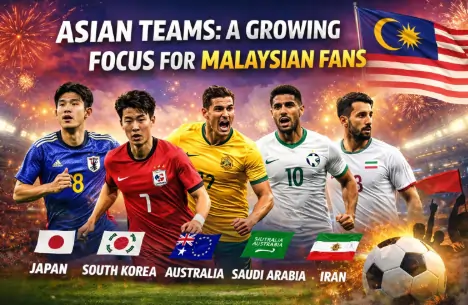
As anticipation builds toward the FIFA World Cup 2026, one storyline is gaining significant momentum across Malaysia — the rising importance of Asian teams on football’s biggest stage. While global attention often gravitates toward European giants and South American powerhouses, Malaysian fans are increasingly shifting their focus toward regional contenders.
The expanded 48-team format has created new pathways and new hope for Asian teams, strengthening belief that the continent can achieve deeper progress and stronger global impact. For Malaysian supporters, this tournament represents more than international football — it represents continental pride.
Asian Teams and the Expanded 48-Team Format
One of the most important structural changes in the upcoming World Cup is the expansion from 32 to 48 teams. This adjustment significantly benefits Asian teams, offering more qualification opportunities and competitive exposure.
Increased Qualification Slots for Asian Teams
Under the expanded format:
- More automatic spots are allocated to the Asian Football Confederation (AFC)
- Additional playoff pathways open for emerging nations
- Competitive balance across the continent improves
- Smaller football programs gain realistic qualification targets
For Malaysian fans, this is a critical development. In previous tournaments, limited spots restricted representation. Now, Asian teams have a stronger platform to demonstrate growth and ambition.
Why Malaysian Fans Closely Follow Asian Teams
Malaysia has a passionate football culture, even when the national team is not competing at the highest global level. When Malaysia does not qualify, supporters naturally rally behind other Asian teams.
Regional Pride and Shared Aspirations
Malaysian fans feel connected to Asian teams because of:
- Similar football development journeys
- Comparable infrastructure challenges
- Shared climate and training conditions
- Regional tournaments such as the AFC Asian Cup
There is a collective sense that when one Asian nation succeeds, it elevates the reputation of the entire continent.
Asian Teams from East Asia: Technical Excellence
East Asia continues to produce some of the continent’s most competitive football programs.
Japan as a Benchmark for Asian Teams
Japan has long set the standard for Asian teams through:
- Structured youth academies
- Tactical discipline
- European league exposure for players
- Consistent World Cup appearances
Malaysian supporters admire Japan’s technical precision, quick transitions, and organized pressing systems. In many ways, Japan symbolizes how Asian teams can blend discipline with attacking creativity.
South Korea’s Competitive Legacy
South Korea remains another pillar among Asian teams, known for:
- High work-rate midfield systems
- Fast attacking transitions
- Strong international tournament experience
Malaysian fans frequently follow South Korean players competing in Europe, increasing familiarity and interest. In 2026, South Korea is expected to remain one of the strongest Asian teams in contention.
West Asian Teams: Tactical Discipline and Physical Strength
West Asia has also produced formidable competitors within the AFC structure.
Saudi Arabia’s Modern Transformation
Saudi Arabia has recently undergone rapid development, making it one of the most closely watched Asian teams.
Key factors include:
- Domestic league investment
- International coaching influence
- Tactical modernization
- Increased player exposure to global competitions
Malaysian fans remember Saudi Arabia’s ability to produce high-profile upsets, reinforcing belief that Asian teams can challenge elite opponents.
Iran’s Defensive Organization
Iran consistently demonstrates defensive solidity and disciplined structure. Among Asian teams, Iran stands out for:
- Compact defensive formations
- Efficient counterattacks
- Tactical patience
- Strong physical conditioning
For Malaysian viewers who appreciate organized football systems, Iran represents a model of resilience.
Australia’s Role Among Asian Teams
Although geographically distinct, Australia competes within the AFC framework and remains one of the strongest Asian teams.
Australia’s strengths include:
- Physical defensive presence
- Tactical adaptability
- Mental resilience in knockout matches
- Balanced squad depth
Malaysian fans often view Australia as a benchmark for consistency among Asian teams.
Emerging Southeast Asian Teams
Beyond established contenders, there is rising curiosity surrounding Southeast Asia’s future.
Countries such as:
- Vietnam
- Thailand
- Indonesia
- Malaysia
are investing in youth development and league infrastructure. While qualification for 2026 remains challenging, the expanded format offers hope that more Asian teams from Southeast Asia could compete globally in the coming decades.
Tactical Evolution of Asian Teams
A major reason Malaysian fans are paying closer attention to Asian teams is the visible tactical progression across the continent.
Modern Pressing Systems
Several Asian teams now integrate:
- Coordinated high pressing
- Rapid wing transitions
- Data-driven performance analysis
- Flexible midfield rotations
The outdated stereotype of Asian squads being purely defensive is fading. Today’s Asian teams display tactical sophistication comparable to established football nations.
Can Asian Teams Go Deep in 2026?
One of the most discussed questions among Malaysian supporters is whether Asian teams can reach the quarterfinals or beyond.
Key Factors for Progress
To succeed in the expanded tournament, Asian teams must demonstrate:
- Squad depth across extended match schedules
- Injury management
- Tactical flexibility
- Psychological resilience
If multiple Asian teams reach knockout rounds, it would mark a historic milestone for the continent.

Asian Teams vs Traditional Powerhouses
Matchups between Asian teams and European or South American giants generate strong interest in Malaysia.
Fans often analyze:
- Tactical contrasts
- Physical matchups
- Midfield control battles
- Defensive organization against elite attackers
A victory by an Asian squad against a defending champion would represent a symbolic shift in global football balance.
Commercial Impact of Asian Teams’ Success
Stronger performances by Asian teams could influence:
- Merchandise sales in Malaysia
- Regional sponsorship opportunities
- Youth academy enrollment
- Increased broadcast viewership
As interest grows, so does commercial potential surrounding continental football.
Digital Engagement Around Asian Teams
Malaysian fans actively discuss Asian teams across digital platforms.
Popular discussion themes include:
- Squad announcements
- Player performance in European leagues
- Tactical previews
- Statistical projections
The growth of social media ensures that conversations surrounding Asian teams remain constant throughout the tournament.
Psychological Shift in Perception of Asian Teams
Perhaps the most significant development is the shift in perception.
In previous decades, Asian teams were often viewed as underdogs simply aiming to compete respectably. Today, expectations have evolved.
Malaysian supporters increasingly believe that Asian teams can:
- Compete tactically
- Defend strategically
- Attack efficiently
- Challenge established powers
This psychological transformation reflects the continent’s broader football development.
Long-Term Benefits for Malaysian Football
The rise of Asian teams could positively influence Malaysia’s domestic football ambitions.
Potential long-term effects include:
- Increased grassroots participation
- Enhanced coaching education programs
- Greater investment in youth academies
- Inspiration for future Malaysian internationals
Seeing neighboring nations succeed provides tangible evidence that global competitiveness is achievable.
What Malaysian Fans Expect from Asian Teams in 2026
Heading into the tournament, Malaysian supporters anticipate:
- Multiple Asian teams advancing to knockout rounds
- Improved goal-scoring efficiency
- Tactical maturity
- Competitive group-stage performances
- Historic upset victories
There is optimism that 2026 could redefine global perception of Asian football.
Final Thoughts: A Defining Era for Asian Teams
The upcoming tournament represents a defining chapter for Asian teams. The expanded 48-team structure, tactical evolution, and growing continental investment create unprecedented opportunity.
For Malaysian fans, following Asian teams is no longer secondary to supporting traditional global giants. It is a source of pride, identity, and belief in regional progress.
If 2026 delivers strong performances from multiple Asian teams, it could permanently shift football’s global hierarchy. Malaysian supporters will be watching closely — not just as spectators, but as invested regional believers in Asia’s rising football power.